RAS toxicity and therapeutic potential of histidyl dipeptides
To maintain homeostasis and perform their functions, cells must continuously detoxify reactive aldehydes (RAS) created from oxidative damage of lipids and sugars, inflammatory enzymes, environmental sources, and more.
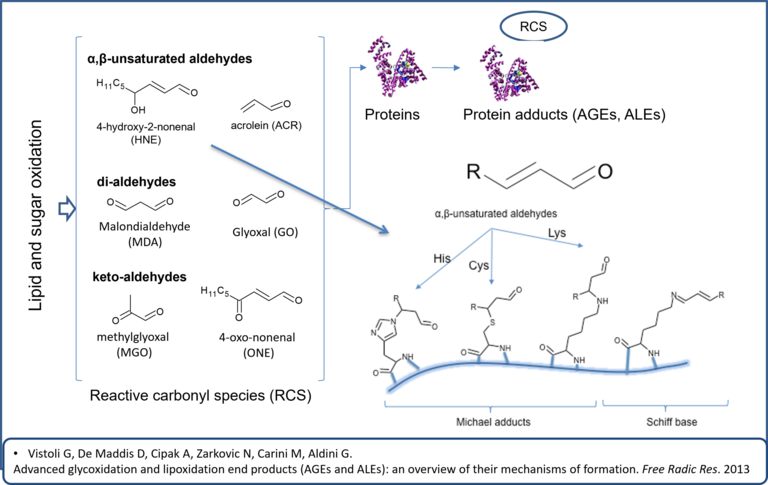
RAS are toxic because they form covalent modifications to proteins and other macromolecules such as DNA and RNA (See Figure at left). Once formed, these modifications can permanently change the function of their targets or facilitate their degradation and removal. When RAS levels exceed detoxification capacity, they cause nonspecific crosslinking, disruption of cellular function and disease. This is particularly true for tissues with high metabolic demand such as liver and heart.
A major regulator of RAS formation in cells is glutathione peroxidase-4 (GPx4), a selenoenzyme that specifically neutralizes lipid peroxides and prevents formation of RAS such as 4-hydroxynonenal (4HNE) and malondialdehyde (MDA). GPx4 is localized in all cellular compartments, particularly mitochondria, where it prevents the downstream consequences of RAS such as inflammation, ferroptosis and senescence, well-known factors that contribute to cardiometabolic disorders, neurodegeneration, cancer and other chronic diseases of aging.
Clinical/Translational Significance
Using rodent models of diet induced obesity and atrial appendage tissue collected during heart surgery, work by our group over the last 12 years has revealed that:
- GPx4 is up-regulated in liver and heart with diet-induced obesity, and obese mice with only one functional GPx4 allele (i.e., one copy of the gpx4 gene, GPx4+/-) have severe cardiometabolic derangements compared to normal (i.e. wild-type) mice. Furthermore, obese GPx4+/- mice display a profound increase in lipid peroxidation, corresponding to greater levels of 4-HNE and MDA accumulation in liver and heart. (PMID 23613536, 26042203, 30226473)
- Heart tissue from patients with T2 diabetes have decreased GPx4 levels and increased RAS damage (PMID 19892241, 26042203).
- Lipid peroxides and RAS are not unconditionally ‘bad,’ and certain types may be beneficial in the heart. Specifically, a high fat diet enriched with omega-3 fatty acids causes an increase in 4-hydroxyhexenal (a RAS) while simultaneously up-regulating antioxidant gene expression in mouse hearts (PMID 21880016).
- Exercise training greatly enhances antioxidant and RAS-detoxifying enzymes in skeletal muscle and heart. An important antioxidant enzyme that increases dramatically with exercise is thioredoxin reductase-2 (TxnRd2), which is localized in mitochondria and responsible for maintaining redox balance in this organelle (PMID 23613536)
Therapeutic Implications
Many experimental and clinical studies have shown that RAS-scavenging can effectively prevent and treat cardiometabolic complications of obesity, diabetes and aging. Our lab has worked with several promising new small molecules that scavenge and detoxify RAS. Some highlights include-
Histidyl dipeptides such as l-carnosine are potent scavengers of RAS and have shown promising effects in patients with metabolic syndrome and heart failure. We have found that l-carnosine delivered in drinking water can block cardiac fibrosis from developing in obese mice (PMID 38348353).
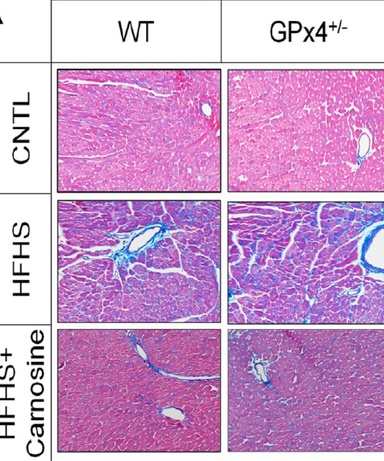
See Figure at right showing cardiac tissue from the mice in this study, blue stain is collagen.
- Our molecular studies indicate that carnosine blocks collagen cross-linking and blunts receptor for advanced glycation end-products (RAGE) activation in heart, both of which contribute to cardiac fibrosis (PMID 34609854, 38348353).
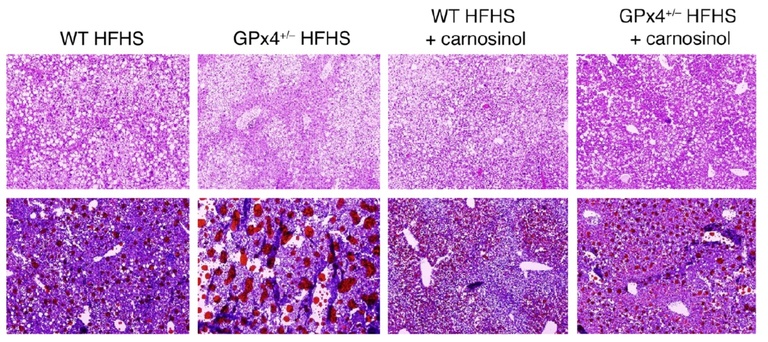
Despite its therapeutic potential, l-carnosine is minimally effective in humans because of high carnosinase activity in blood. Carnosinase breaks down l-carnosine into histidine and B-alanine, rendering it ineffective at scavenging RAS. Our lab has collaborated with pharmaceutical scientists from University of Milan to show that carnosinol, an alcohol derivative of l-carnosine, can completely reverse fatty liver and pre-diabetes in rodent models of diet-induced obesity (PMID 30226473). See Figure below showing triglycerides in liver tissue stained with oil red O.
- We recently found that patients with severe left ventricular dysfunction and heart failure have lower levels of carnosinase activity in their blood. Although the exact mechanisms and implications for this lower activity are not fully understood, these findings suggest that l-carnosine metabolism is altered by poor cardiovascular function, and this could provide opportunities for l-carnosine supplementation and therapy in these patients (PMID 40141250).